
3D printing builds an object layer by layer from a digital file, adding material only where it is needed. At KUBOLAB the process is FDM — fused filament deposition — in renewable-source PLA. It isn’t a technique adopted because it’s on trend: it’s the only process that lets the pieces exist with the geometry they have, at the scale they have, in the material they’re made of.
3D printing in fashion is no longer new. But what it means in practice, for those who design and those who wear, is still little understood. It isn’t just a new way of manufacturing — it’s a change in the relationship between design, production and consumption.
How precision 3D printing works
FDM stands for Fused Deposition Modeling. It’s the most widespread technology for 3D printing polymers, and also the one that offers the most control over a piece’s mechanical and aesthetic properties when well calibrated.
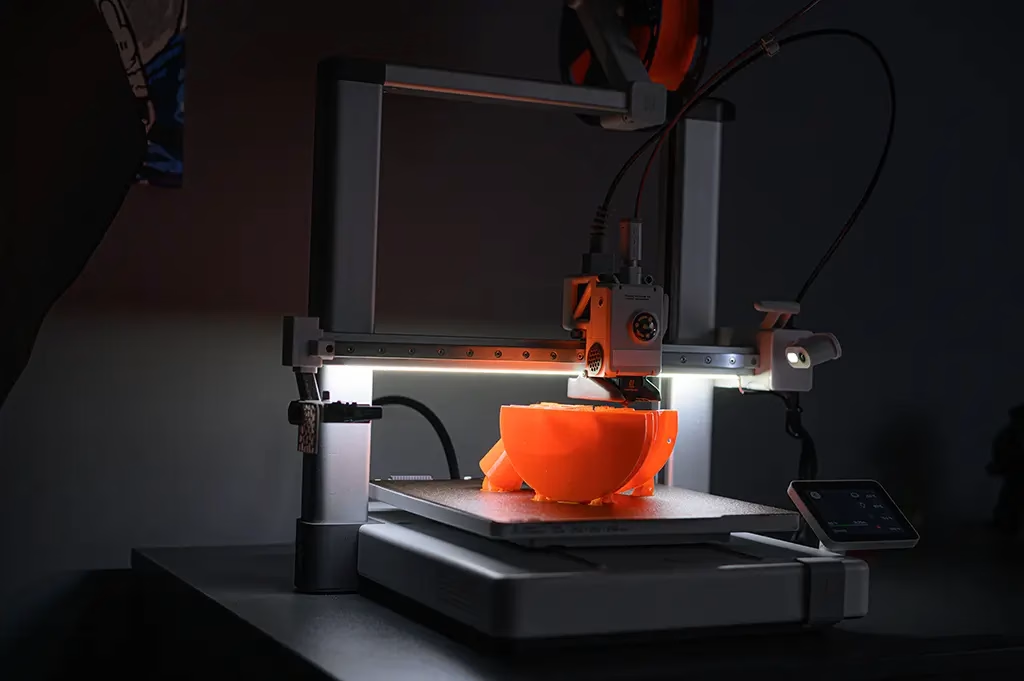
It works additively: the object is built layer by layer, from the bottom up, from a filament heated to its melting point and deposited with millimetre precision onto the surface below. Each layer bonds to the one before. The object emerges gradually — it isn’t cut, injected or cast in a mould.
This additive process is what allows geometries that conventional processes can’t reproduce: internal cavities, overhanging structures, organic forms with continuous curvature, geometric lattices with varying thickness across the piece.
The process, step by step
1. Digital modelling. Everything starts with a model built in 3D software — not a scan of an existing object, but a geometric construction that starts from an idea about structure, surface or presence on the body. Proportions and thicknesses are tested and refined iteratively.
2. Slicing. The model is converted into hundreds or thousands of layers by slicing software, which also calculates the path the nozzle will follow on each one. This is where layer height, speed, temperature and internal infill are set.
3. Printing layer by layer. The printer deposits the filament in continuous lines. Each layer fuses to the previous one until the piece is complete. Geometry, texture and strength are formed at this stage — and can’t be corrected afterwards.
4. Cooling. PLA cools quickly and solidifies, which is part of what makes the piece precise: the form that sets is exactly the form that was designed.
5. Support removal and assembly. The supports calculated for the overhanging areas are removed and the parts are assembled — the ring is glued, the brooch gets its magnets, the necklace gets its clasp. Each piece is inspected individually.
The calibration changes from piece to piece. A brooch with fine details needs different settings from a volumetric necklace. That adjustment is part of the design, not just of production.
The layer is a choice, not a defect
This is where KUBOLAB parts ways with almost everyone who 3D-prints: no piece is sanded, polished or painted. There is no finishing post-process. The piece leaves as the machine made it — only the supports are removed and it is assembled.
That isn’t skipping a step to save time. It’s the premise of the work. The layer is the trace of the process, and it is controlled, not accidental. The decision is made in the design, through the layer height:
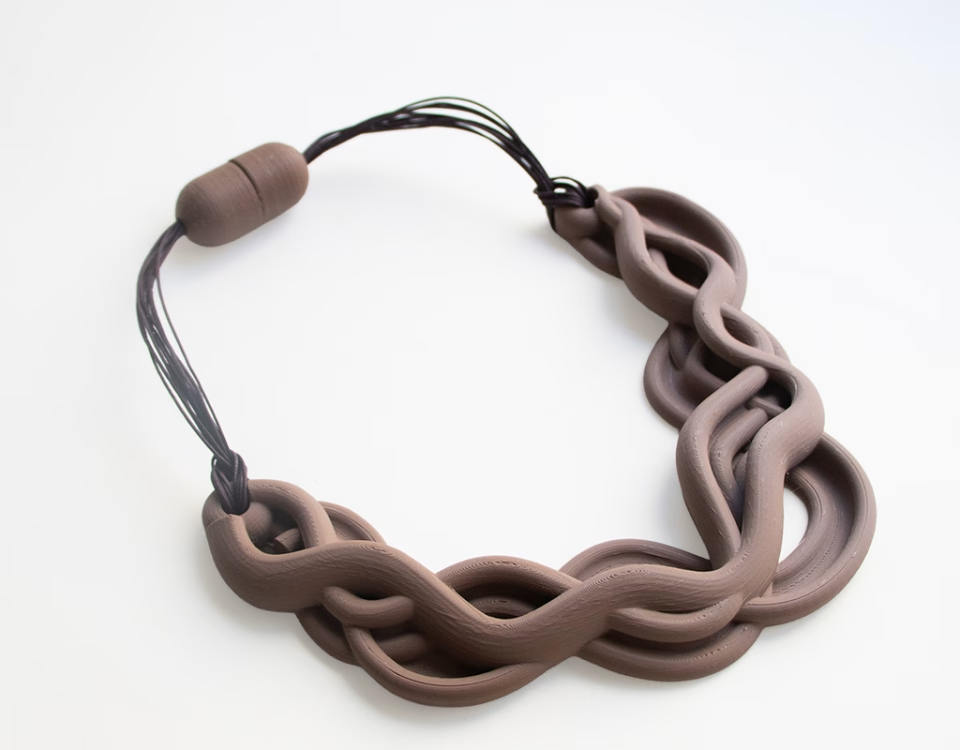
- A thick layer, to show it. The Supercoil Necklace is printed at 0.24 mm — the layer reads from a distance, as texture and as structure.
- A fine layer, to minimise it. The Radia Brooch is printed at 0.12 mm — more layers, thinner, and the surface approaches the continuous.
Two pieces, the same material, the same machine, opposite decisions about what the surface should say. Seeing the layer on a KUBOLAB piece isn’t a sign of an unfinished surface. It’s the process made visible, because it was chosen that way.
Why 3D printing changed accessory design
Before accessible 3D printing, producing a piece with complex geometry required either an expensive mould, hours of handwork, or simplifying the form to make it manufacturable. The process dictated the design.
3D printing reversed that logic. The designer designs the form the idea demands — and the process adapts. Forms that are impossible in casting or CNC cutting become manufacturable with the same equipment that produces simple ones. In 3D printing, the cost of geometric complexity is almost zero.
For an independent design studio, that is transformative. No form is forbidden by a technical limitation. There is only what the formal research asks for — and the process finds a way there.
No mould, no waste
Made-to-order production eliminates two of the fashion industry’s biggest sources of waste: stock and process scrap.
In conventional production by injection moulding or casting, the mould is a high fixed cost that has to be spread over large volumes. That forces production in advance — pieces that may or may not sell. What doesn’t sell becomes stock, then a clearance sale, then waste.
In made-to-order 3D printing there is no mould and no minimum-volume pressure. Each piece is produced when it’s ordered, with exactly the material needed. No leftover filament, no injection scrap, no pieces produced without a destination.
What this means for the person buying
When you buy a KUBOLAB accessory, you receive a piece that didn’t exist before your order. The digital model is in the studio’s files, but printing began when your order arrived.
That has practical implications. Made-to-order production takes up to 7 business days after confirmation. When a unit is available, it ships straight away. Either way the piece has been individually inspected — it didn’t come out of a box of identical dozens.
It’s a model that takes more time than buying from a big store. And it delivers what a big store can’t: a traceable process, a conscious material and independent design that wasn’t made for volume — it was made for form.
Two practical questions about the result of this process have answers of their own: does the piece break? and how much does it weigh?
See how this translates into pieces: the necklaces, the brooches, the earrings and the rings, or the full collection in the shop.